Leave Your Message

7 Tips for Choosing the Right Roll Up Fire Door?

Choosing the right Roll Up Fire Door is not a simple matter of comparing prices. It is a safety decision shaped by fire risk, building design, traffic, maintenance, and local approval requirements.

Robert Solomon, former director of Building Fire Protection at NFPA, stated, “Fire doors are a critical part of a building’s passive fire protection system.” His point deserves attention. A Roll Up Fire Door must do more than close an opening. It should help limit smoke, flame, and heat while supporting safe evacuation and fire compartmentation. The correct choice begins with the wall rating, opening size, temperature exposure, and expected fire scenario. Warehouse loading bays need different performance from commercial kitchens or industrial workshops. Think about daily use, too. Forklifts, dust, moisture, and repeated impacts can quickly expose weak components. Small details matter.

A dependable evaluation should examine the fire-resistance rating, listing or certification, release mechanism, guide rails, curtain construction, sensing devices, and emergency operation. Installation quality matters just as much as the product specification. A certified door can fail when fitted poorly. That is uncomfortable, but true. Regular inspection is also essential. Look for damaged slats, blocked tracks, loose hardware, corrosion, and doors that do not fully close. Choosing the cheapest model may appear practical, yet replacement costs and operational disruption can be higher. This guide presents seven practical tips for selecting a Roll Up Fire Door that fits the building, the hazard, and the people who depend on it. There is no perfect choice. There is only a better-informed one.
7 Tips for Choosing the Right Roll Up Fire Door?

Define the Fire Risks and Protection Goals for Your Facility

Before choosing a roll up fire door, define the fire risks inside your facility. A warehouse storing plastics faces faster flame spread than a concrete archive. Kitchens, battery rooms, loading bays, and paint areas require different protection goals.

NFPA’s Fire Loss in the United States During 2022 reported 1,504,500 fires and approximately $18.1 billion in property damage. Those figures show why broad assumptions can become expensive mistakes.

Map each hazard by location, fuel type, temperature, smoke movement, and employee exposure. Then decide what the door must protect: evacuation routes, critical equipment, neighboring zones, or the building structure.

NFPA 80 provides installation and maintenance guidance for fire doors and other opening protectives. The door rating should match the wall assembly and the expected exposure. A higher rating is not automatically a better solution.

Keep it practical. Imagine a shutter closing while forklifts move nearby, alarms sound, and visibility drops. Will it close reliably? Will staff understand the release system?

A site survey can reveal gaps that drawings miss. However, risk assessments are not perfect. Storage layouts change, and maintenance records can be incomplete. Review them regularly.

Test the door under realistic conditions, not only during a quiet inspection. Select a door that supports the facility’s actual response plan, not an idealized one.

Match Door Materials and Ratings to the Hazard Conditions

7 Tips for Choosing the Right Roll Up Fire Door

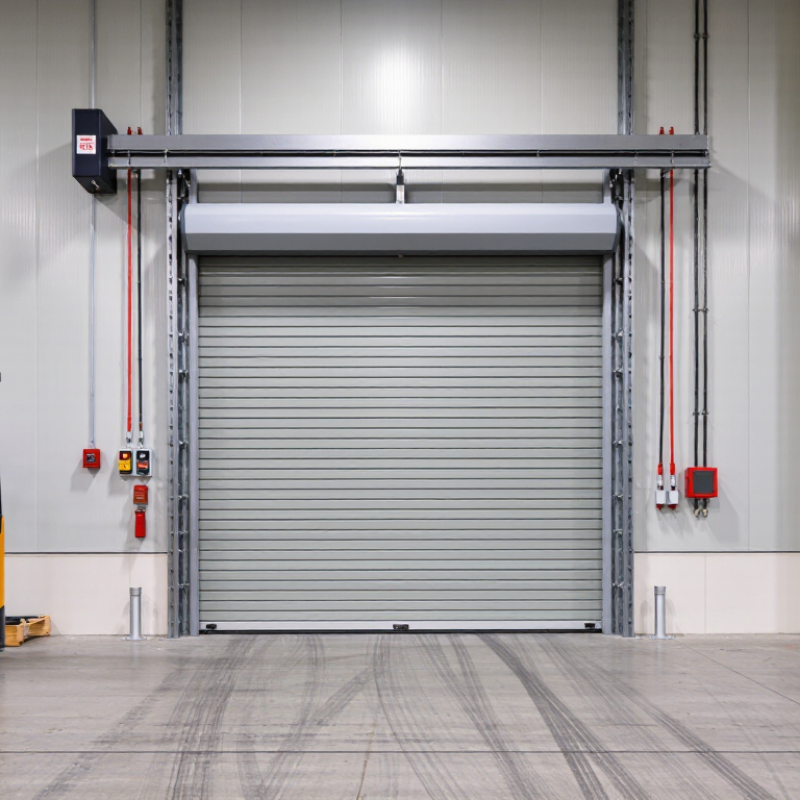
Choosing a roll up fire door starts with the hazard, not the catalog photograph. Map heat, flame, smoke, impact, moisture, and traffic frequency at the opening. Steel is common for general industrial areas because it offers strength and dependable fire resistance. Stainless steel may suit damp, washdown, or corrosive environments better. However, a corrosion-resistant finish does not replace correct fire testing. That detail is easy to overlook.

The door’s fire rating must match the actual exposure period and building compartment design. A higher rating is not automatically the best choice. It may add cost, weight, or operating limits without solving the site’s main risk. Check the tested door assembly, including the curtain, guides, hood, mounting surface, closing system, and vision panels. Ask for clear certification and installation requirements. Ratings should also align with applicable local building and fire safety regulations.

Real conditions often challenge the original specification. Dust can restrict guides, while forklifts can damage poorly protected edges. Frequent opening may require a different operating cycle than a low-traffic storage room. During a site walkthrough, inspect nearby heat sources, sprinkler coverage, airflow, and escape routes. A practical mistake is choosing materials from habit. I have seen suitable steel doors placed in environments where moisture quickly became the real hazard. Recheck the choice after installation. Perfect matching is rare. Reliability comes from evidence, maintenance access, and honest review.

7 Tips for Choosing the Right Roll Up Fire Door? - Match Door Materials and Ratings to the Hazard Conditions

Tip Hazard Condition Recommended Door Material Typical Fire-Protection Rating Important Selection Checks
1. Match the rating to the opening requirement A wall or compartment requiring a protected opening Listed, tested steel rolling fire door assembly Common listed ratings include 45 minutes, 60 minutes, 90 minutes, and 180 minutes Confirm the required opening-protective rating from the adopted building and fire codes. The required door rating is not determined by door material alone.
2. Choose steel for general fire exposure Commercial, industrial, storage, and service openings with ordinary fire risk Galvanized or coated steel curtain, guides, hood, and brackets Use the complete listed assembly rating required for the opening Check curtain gauge, guide construction, mounting surface, clearances, and whether the assembly has been tested as a complete unit.
3. Use stainless steel in corrosive areas Wash-down rooms, food-processing areas, coastal locations, and chemical environments Stainless steel components where corrosion resistance is required The same fire rating must be available for the specified stainless-steel configuration Verify compatibility with cleaning chemicals, drainage conditions, fasteners, seals, and the fire listing. A corrosion-resistant finish does not automatically provide a fire rating.
4. Consider smoke movement as well as flames Healthcare, residential, assembly, or compartmented buildings where smoke control is important Steel fire door assembly with listed smoke-control features, where required Fire rating plus the applicable smoke-leakage or air-leakage classification Check perimeter seals, guide seals, bottom-bar contact, automatic closing, and the code requirement for smoke-and-draft control assemblies.
5. Account for impact and traffic Forklift routes, loading docks, warehouses, and frequently operated openings Heavy-duty steel construction with reinforced guides and bottom bar Maintain the required fire rating while selecting the impact-resistant configuration Review cycle rating, operating speed, guide retention, bottom-bar design, safety sensors, and whether impact features are included in the tested assembly.
6. Evaluate heat transfer and combustible contents Rooms containing flammable goods, high heat loads, or combustible storage near the opening Insulated or specially designed steel assembly only when specifically listed for the application Select the required fire rating and any temperature-rise or hose-stream performance stated by the applicable listing Check whether the project requires temperature-rise limits, radiant-heat control, fusible-link operation, or connection to an automatic fire-alarm system.
7. Verify testing, installation, and maintenance Any opening intended to limit the spread of fire or smoke Only a complete, compatible, listed assembly with approved replacement parts Tested and labeled in accordance with the applicable local code and recognized fire-door test standard Confirm labels, self-closing operation, fusible links or release devices, clearances, inspection access, annual inspection requirements, and periodic drop testing where required.

Note: Fire-door ratings, smoke-control requirements, installation details, and inspection intervals must be confirmed against the building code and fire-safety standards adopted at the project location. The door, guides, hardware, release device, and supporting construction should be treated as one tested assembly.

Check Size, Mounting Space, and Installation Requirements

Tip 1: Measure the clear opening, not the old door curtain. Record width, height, headroom, and side-room space. A few millimetres can affect guides, brackets, and the bottom bar.

Tip 2: Check the available mounting space above the opening. The curtain roll, hood, motor, and service access need separate clearance. NFPA 80 requires fire door assemblies to be installed and maintained according to approved instructions.

Tip 3: Confirm the wall type before selecting brackets. Masonry, steel, and framed walls distribute loads differently.

Tip 4: Review nearby ducts, lights, sprinklers, and beams. They often obstruct the hood or guide rails.

Tip 5: Match the door rating to the opening’s approved fire-resistance design. NFPA’s Fire Loss in the United States report recorded about 1.39 million fires in 2023. Correct installation remains a practical risk-control measure. Still, a rated door cannot compensate for poor building design.

Tip 6: Plan electrical access, emergency release, and control-panel locations before delivery. Keep service points reachable without ladders whenever possible.

Tip 7: Require commissioning by a qualified installer, including drop testing and alignment checks. NFPA 80 calls for periodic inspection and testing, generally at least annually. The schedule may vary by local requirements and site conditions. A drawing can still be wrong. Recheck measurements on site, especially after flooring, cladding, or ceiling work changes the opening.

Evaluate Controls, Safety Features, and Emergency Operation

7 Tips for Choosing the Right Roll Up Fire Door

Control design deserves careful attention. Choose a system with clearly labeled open, close, stop, and emergency controls. The fire alarm interface should initiate closure without relying on staff memory. NFPA 80, Standard for Fire Doors and Other Opening Protectives, requires fire door assemblies to receive inspection and testing at least annually. Ask for documented test records, not verbal assurances. A door that closes too quickly can injure people; one that closes too slowly may allow fire and smoke to spread.

Inspect the safety features in real conditions. Look for obstruction detection, controlled descent, audible alarms, and a manual release that employees can reach quickly. Test the door during a simulated power failure. It should move into its required safe position, while emergency access remains practical. NFPA’s Fire Loss in the United States During 2022 estimated 1.5 million fires and $18.1 billion in property damage. These figures make dependable closure more than a purchasing detail. It is a life-safety decision.

Do not overlook emergency operation training. Staff should know how to stop a descending curtain, report a fault, and reset the system safely. Keep the operating area clear. During site checks, small problems often appear first: a dirty guide rail, a weak battery, or a control button hidden behind stored materials. That is easy to miss. Require commissioning records, maintenance intervals, and a written emergency procedure. Review them after renovations, staffing changes, or alarm-system upgrades. The cheapest control package may become the most expensive weakness.

Compare Maintenance Needs, Compliance, and Long-Term Cost

7 Tips for Choosing the Right Roll Up Fire Door

A roll up fire door should protect more than an opening. It should remain serviceable, compliant, and financially sensible over many years. Check the required fire rating, opening size, operating cycle, and surrounding hazards. Confirm that the complete assembly is tested and listed for its intended use. A door with a higher rating is not automatically the better choice.

NFPA 80 requires fire door assemblies to receive inspection and testing at least annually. Ask who will perform this work, what records will be supplied, and how quickly replacement parts can arrive. During site reviews, a door may look clean while its guides collect dust or its fusible link shows corrosion. Small faults become expensive interruptions. Keep inspection logs, test closing speed, examine curtains and guides, and verify that safety devices work without forcing them. Local authorities may impose additional requirements, so involve the authority having jurisdiction early.

Long-term cost includes labor, downtime, energy loss, repairs, and eventual replacement. NFPA’s Fire Loss in the United States During 2023 estimated 1,388,500 fires and 17.1 billion dollars in direct property damage. That figure does not make every expensive door worthwhile, but it shows why weak protection can become costly. Compare five-year service costs, not only the purchase price. Ask for realistic cycle ratings and maintenance intervals. I would also leave a contingency budget; forecasts are rarely perfect. The cheapest option can be the most expensive when a failed door blocks a loading area or remains open during a critical event.

7 Tips for Choosing the Right Roll-Up Fire Door

Compare maintenance needs, compliance readiness, and long-term ownership cost before specifying a door.

1. Confirm the rating

Match the required fire-resistance rating, opening size, wall assembly, and local authority requirements.

2. Plan for annual inspection

NFPA 80 generally requires fire door assemblies to be inspected and documented at least annually in applicable jurisdictions.

3. Evaluate traffic intensity

Higher opening frequency increases wear on guides, curtains, springs, brakes, release devices, and controls.

4. Check release and closing systems

Verify that fusible links, detectors, alarms, power supplies, and automatic closing functions can be tested and serviced.

5. Compare maintenance access

Allow safe access to the barrel, guides, bottom bar, control panel, and fire-release components.

6. Review documentation

Keep installation records, inspection forms, test results, repair logs, and approved replacement-part information.

7. Calculate total ownership cost

Include installation, preventive maintenance, repairs, testing, downtime, and replacement planning—not only the purchase price.

The chart uses a transparent planning benchmark: the low-traffic profile is normalized to 100, while medium- and high-traffic profiles reflect progressively higher maintenance, testing, repair, and downtime exposure. Actual costs vary by jurisdiction, opening size, duty cycle, access conditions, labor rates, and required fire rating. Confirm final requirements with the applicable code, manufacturer documentation, and authority having jurisdiction.